
Strength Training

In RIE® and Pikler® spaces, we talk a lot about development — about freedom of movement and uninterrupted play. We observe. We wait. We trust.
But what if we applied the same reverence for development to ourselves?
What if we thought about our own emotional and cognitive growth as a kind of strength training?
Not the punishing, hustle-driven kind. Not the “fix yourself” kind.
But the slow, attuned, incremental kind.
The kind we already believe in for children.
The Parallel We Rarely Name
When an infant is learning to stand, we don’t place them on their feet and command, “Stand up straight.” We don’t rush them into walking because it would make life more convenient. We don’t compare their timeline to the child next door.
We trust the process of development.
We know strength builds in tiny increments:
Torso shifts.
A shoulder lifts.
Hips roll.
Hands press into the floor.
A wiggle becomes a crawl.
Torso lifts, and a crawl becomes a creep.
From creeping, there’s pulling.
From pulling, there’s pulling to stand.
And then, eventually … they’re standing.
Each step contains hundreds of micro-adjustments.
And we protect that process because we understand something fundamental: strength that is built authentically becomes integrated.
So here’s the question:
What if we approached our own emotional and cognitive growth the same way?
Emotional Strength Training
Many of us were not raised with attuned observation, respectful communication, or emotional literacy. We are often trying to give our children something we are still learning to give ourselves.
Patience.
Boundaries.
Regulation.
Self-trust.
Repair.
These are not personality traits. They are capacities. And capacities can be strengthened.
But only if we break. them. down.
If “I want to be more patient” is the goal, that’s like saying, “I want to deadlift 200 pounds!” It’s too big. It’s abstract. It collapses under its own weight.
The RIE lens asks us to observe more closely.
What is impatience made of?
Maybe:
A tightening in the chest.
A belief that we’re running out of time.
A fear that we’re failing.
A childhood echo of being rushed.
So strength training begins here:
Noticing the body cue.
Pausing before reacting.
Narrating what’s happening (“You’re having a hard time putting your shoes on.”).
Allowing 10 extra seconds or more… before intervening.
But start there.
That’s the rep.
Ten extra seconds.
That is strength training.
Cognitive Strength Training
In RIE and Pikler environments, children repeat movements again and again. Repetition isn’t stagnation; it’s integration.
Adults need repetition, too.
Maybe an emerging skill for you is:
Tolerating disagreement.
Listening without defending.
Saying “I don’t know.”
Letting your child struggle.
Trusting independent play.
Instead of “I will completely transform my reactions,” try:
One conversation where you ask one more curious question.
One moment where you allow frustration without fixing it.
One pause before correcting.
One breath before explaining.
Micro-reps.
We would never expect an infant to skip crawling and go straight to sprinting. Yet we expect ourselves to leap from generational patterns to enlightened parenting overnight.
Strength does not work that way.
Why This Matters Now and for Future Generations
The RIE and Pikler approaches are rooted in respect — not as a technique, but as a stance.
Respect means:
Seeing development as unfolding.
Trusting competence.
Valuing autonomy.
Minimizing unnecessary interference.
When we strength-train our own nervous systems, our own beliefs, our own patterns, we interrupt cycles.
A parent who can tolerate discomfort without collapsing into control is offering their child something truly revolutionary.
A caregiver who can repair after rupture is modeling relational resilience.
A family system that normalizes growth — messy, slow, iterative growth — becomes fertile ground for secure attachment.
This is generational work.
Not because we are perfect.
But because we are practicing.
The Smallest Possible Step
In RIE and Pikler, environments are prepared to make success likely. Furniture is low. Materials are intentional. Movement is free but safe.
What would it mean to prepare your own environment for emotional growth?
Go to bed 20 minutes earlier so you have more capacity.
Lower one expectation.
Build in a daily five-minute pause.
Call or text a friend instead of scrolling.
Journal just one sentence to start … instead of five pages.
Strength training works because the weight is appropriate.
If it’s too heavy, you compensate.
If it’s too light, you don’t grow.
If it’s just right, you do.
Children show us this constantly. They seek just-manageable challenges. They return to what stretches them but does not overwhelm them.
We can do the same.
A Different Kind of Discipline
In fitness culture, discipline is often framed as force.
In RIE and Pikler-informed caregiving, discipline (its root meaning: teaching) is relational and developmental.
Strength training for the self is not about self-criticism. It is about structured compassion.
It sounds like:
“This is challenging for me.”
“I am learning.”
“I will try again.”
“I don’t need to master this today.”
It looks like repetition.
It feels like humility.
It requires patience.
The same patience we offer our children.
For Ourselves — Not Just Our Children
Many parents enter respectful caregiving spaces with a quiet urgency: I don’t want to pass down what hurt me.
That is beautiful.
But growth fueled only by fear becomes brittle.
What if we trained not just to prevent harm, but to expand our own lives?
To feel more regulated.
To experience more connection.
To think more flexibly.
To rest without guilt.
To tolerate complexity.
Your growth is not just a strategy for raising children well.
It is your life.
And when children see adults engaged in honest growth — naming limits, repairing mistakes, taking pauses, seeking support — they internalize something profound:
Development does not stop at childhood.
The Long View
Dr. Pikler and Magda Gerber wrote about the importance of allowing children the time and space to develop at their own rhythm.
What if we granted ourselves the same dignity?
Instead of:
“I should be better by now.”
Try:
“I am building strength.”
Instead of:
“I keep failing at this.”
Try:
“I’m still in training.”
Because that’s what this is.
Not self-optimization.
Not moral superiority.
Not parenting perfection.
Strength training.
Slow.
Intentional.
Incremental.
Relational.
And every small rep — every breath before reacting, every repair after rupture, every moment of observing instead of controlling — reshapes not just a single interaction, but a lineage.
The infant shifting and lifting to move.
The parent pausing before speaking.
The grandchild who grows up in a home where development is trusted.
All of it is connected.
And it begins with the smallest possible moment and the smallest possible movement.
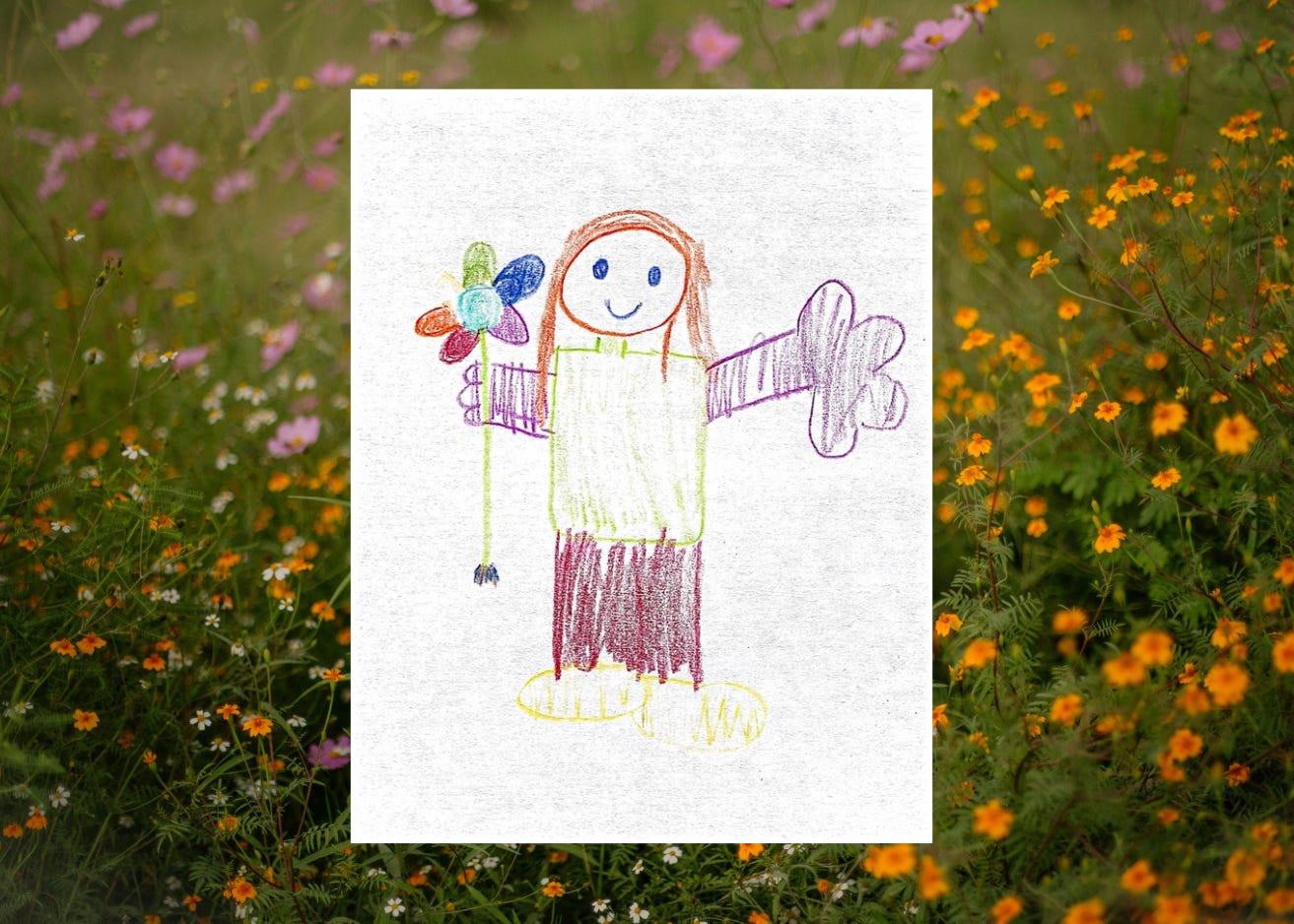
Photo by Shiebi AL from Pexels. Family art from Leith Speer Barton.
 | A guest post by
|